Few automotive brands have shaped the idea of a supercar as strongly as Lamborghini. From the breathtaking Miura of the 1960s to the electrified Revuelto of today, Lamborghini’s flagship V12 bloodline has never been just about speed. It has been about drama, design shock value, mechanical theatre and the ability to make every generation dream bigger.
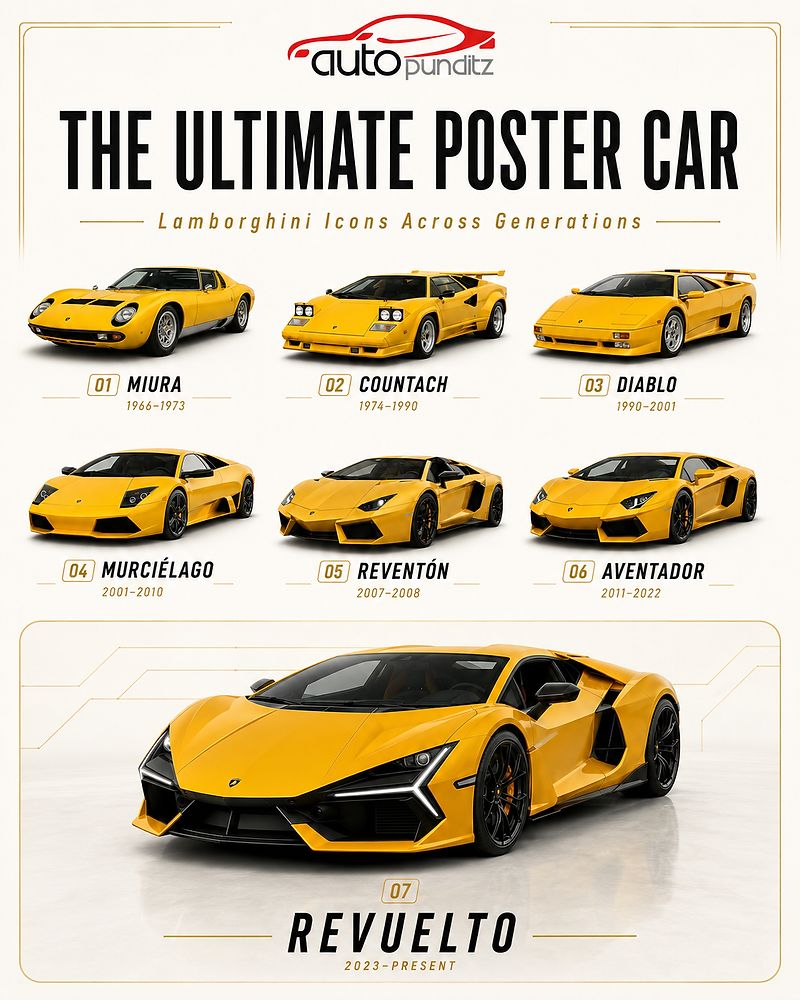
The image traces an iconic lineage: Miura, Countach, Diablo, Murciélago, Aventador, Reventón and Revuelto. Each car represents a different era of Lamborghini’s evolution — from analogue beauty to wedge-shaped aggression, from raw V12 power to carbon-fibre engineering, and now to hybrid performance.
The Lamborghini Miura, introduced in 1966, is widely remembered as the car that changed the supercar formula. Its mid-mounted V12 layout, low-slung body and dramatic proportions created the template that many modern supercars still follow. Lamborghini’s own heritage material calls the Miura the forerunner of all Lamborghini V12 super sports cars.
What made the Miura special was not just its performance, but the way it looked. It was elegant, compact and emotional — very different from the aggressive Lamborghinis that would follow. It proved that Lamborghini could challenge Ferrari not by copying it, but by creating a new design language altogether.
If the Miura was beauty, the Countach was shock. The Countach LP500 prototype appeared at the 1971 Geneva Motor Show, and production of the Countach LP400 began in 1974 with a 4.0-litre V12. Lamborghini notes that the name “Countach” came from a Piedmontese expression of amazement — an apt description for a car that looked like it had landed from the future.
The Countach introduced the sharp wedge profile and scissor doors that became central to Lamborghini’s identity. Later versions such as the LP400S and Quattrovalvole added wider tyres, flared arches, bigger engines and the famous rear wing, making the Countach one of the most recognisable supercars ever built.
The Diablo replaced the Countach in 1990 and carried Lamborghini into a new decade. Its 5.7-litre V12 pushed performance beyond 320 km/h, and Lamborghini says more than 2,900 units were produced, including Roadster versions.
The Diablo was important because it modernised the Lamborghini supercar without losing the madness. It still had the low stance, wide body and scissor doors, but it was more refined and more capable than the Countach. For many enthusiasts who grew up in the 1990s, the Diablo was the definitive bedroom-wall Lamborghini.
The Murciélago, launched in 2001, was the first new Lamborghini developed after the brand entered the Audi-Volkswagen Group era. Lamborghini describes it as the first brand-new car of that era, powered by a V12 and equipped with four-wheel drive as standard.
This was a turning point. The Murciélago retained the drama of classic Lamborghinis, but quality, usability and engineering precision improved significantly. It marked the beginning of Lamborghini becoming not just an exotic poster brand, but a more mature global performance manufacturer.
Key Insights & Highlights
The Reventón was produced in very limited numbers and acted as a design bridge between the Murciélago and the Aventador. Its stealth-fighter-inspired styling previewed the sharper, more technical design direction Lamborghini would take in the following decade.
Unlike the core production flagships, the Reventón was more of a collector’s statement — a rare, dramatic halo car designed to show what Lamborghini’s future visual language could look like.
The Aventador LP 700-4 arrived in 2011 as the successor to the Murciélago. Lamborghini says it used a carbon-fibre chassis and a new mid-mounted rear V12 producing 700 CV, positioning it as the brand’s new benchmark for power, technology and futuristic design.
The Aventador became one of the most successful modern Lamborghini flagships. It kept the naturally aspirated V12 alive at a time when the industry was moving toward turbocharging and downsizing. Its long production run, multiple derivatives and aggressive road presence made it a modern icon.
The Revuelto, introduced in 2023, marks the biggest shift in Lamborghini’s flagship history. It is Lamborghini’s first HPEV — High Performance Electrified Vehicle — combining a naturally aspirated V12 with three electric motors. Lamborghini lists the Revuelto’s combined output at 1,015 CV, with a top speed of over 350 km/h and 0–100 km/h in 2.5 seconds.
This is not electrification for efficiency alone. In true Lamborghini fashion, the hybrid system is used to add performance, response and theatre. The Revuelto shows that the V12 is not disappearing from Lamborghini’s identity — it is evolving.
The journey from Miura to Revuelto is not a simple timeline of faster cars. It is the story of how Lamborghini repeatedly changed the definition of a supercar.
The Miura created the mid-engine dream.The Countach made the supercar a visual event.The Diablo turned Lamborghini into a 1990s performance icon.The Murciélago brought Audi-era engineering discipline.The Aventador preserved the naturally aspirated V12 in the modern age.The Revuelto proves that electrification can support, rather than replace, Lamborghini’s emotional appeal.
Lamborghini’s V12 lineage is a reminder that innovation in the automotive world is not only about technology. It is also about emotion, design and cultural impact. Each of these cars became famous because it looked impossible, sounded unforgettable and made performance feel theatrical.
As the global performance car industry moves toward electrification, Lamborghini’s challenge is clear: it must preserve the madness while adopting new technology. With the Revuelto, the brand has taken its first major step into that future — not by abandoning the V12, but by giving it an electrified second life.