The View From India
Looking at World Affairs from the Indian perspective.
First Day First Show
News and reviews from the world of cinema and streaming.
Today’s Cache
Your download of the top 5 technology stories of the day.
Data Point
Decoding the headlines with facts, figures, and numbers
THEdge
At the cutting edge of education and careers
Health Matters
Ramya Kannan writes to you on getting to good health, and staying there
Gender Agenda
Stories from beyond the binary.
The Hindu On Books
Books of the week, reviews, excerpts, new titles and features.
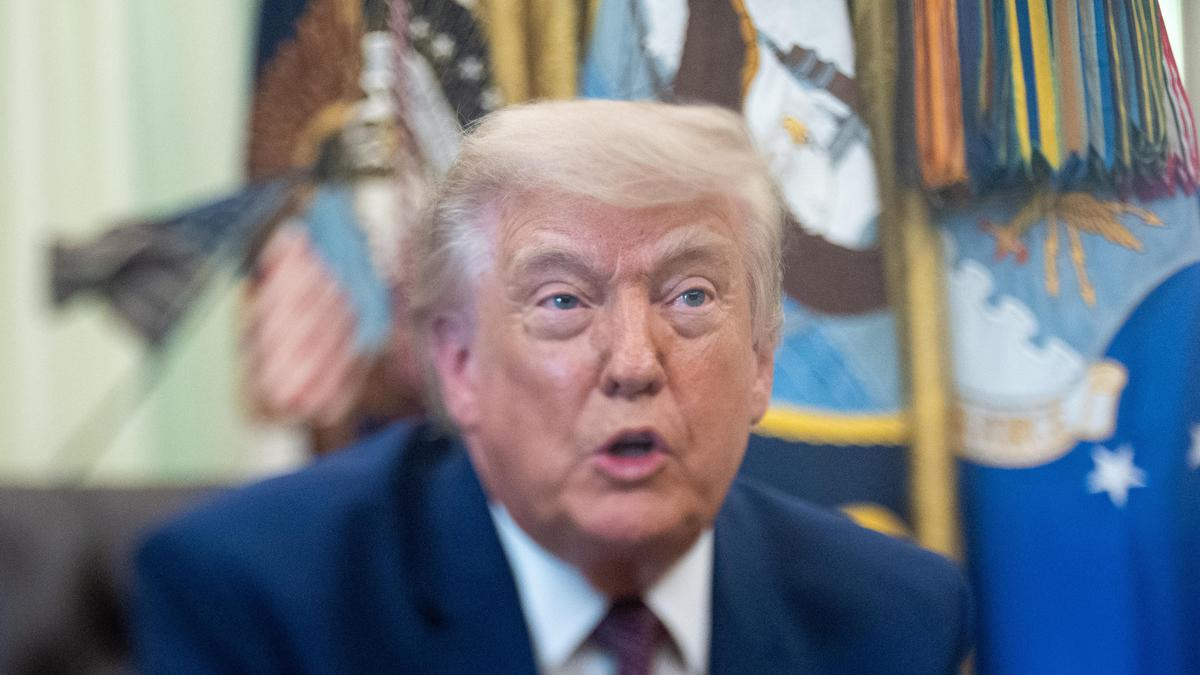
U.S. President Donald Trump. File
| Photo Credit:
AP
Israel and Lebanon agreed to implement a ceasefire but said it would require a “complete cessation” of fire by Iran-backed Hezbollah, according to a joint statement after U.S.-led talks in Washington. The two sides, which do not have formal diplomatic relations, also agreed to create “pilot zones” in which the Lebanese armed forces “will take exclusive control of the territory to the exclusion of all non-state actors”. The joint statement said the ceasefire was “contingent on a complete cessation” of fire by Hezbollah as well as evacuation of the group’s operatives from southern Lebanon.
The development came despite continued cross-border attacks, with Hezbollah saying it targeted Israeli troops and Israeli strikes killing at least nine people in southern Lebanon.
U.S. President Donald Trump had said he wanted to separate talks on the conflict in Lebanon and those on the war with Iran. Tehran, however, insists the conflicts are linked and its Foreign Minister Abbas Araghchi warned that any attack on Beirut would trigger a “full-scale resumption” of war. Mr. Araghchi also said that “no tangible progress” has been made in negotiations to end the West Asia war as fresh U.S. and Iranian strikes strained a fragile ceasefire. In contrast, Mr. Trump voiced optimism again, telling reporters at the White House “it could happen…over the weekend.”
Meanwhile, oil prices eased on Thursday (June 4, 2026) as Israel and Lebanon’s ceasefire agreement boosted hopes for a broader deal to end the war in West Asia, while the U.S. House approved a resolution seeking to curb Mr. Trump’s war powers.
President Emmanuel Macron said today that France backs the ceasefire in Lebanon after the announcement of an agreement in Washington.
The French head of state told reporters on a visit to Montenegro: “We support the ceasefire between Lebanon and Israel and everything that helps restore peace, combat terrorist activities, and fully establish Lebanon’s sovereignty and territorial integrity.
Key Insights & Highlights
“France is, of course, as we have always been, available to move forward along this path. A coordination mechanism has been put in place where the United States and France are working together,” he added.
Key Insights & Highlights
“If the ceasefire is serious, this is the mechanism that must be reactivated, so that we can follow up and verify its implementation.”
Pakistan today said it is in touch with the relevant parties to the West Asia conflict and working to bring permanent peace between the U.S. and Iran despite the latest escalation in the volatile region.
Foreign Office spokesperson Tahir Andrabi also said the tension in the Gulf region was worrisome and hoped that the parties would adhere to the ceasefire understanding.
Key Insights & Highlights
“The situation obviously is fragile, particularly after the recent spate of armed exchanges, but we remain engaged. Our channels of communication with the relevant parties are open,” he said at the weekly press briefing in Islamabad.
Key Insights & Highlights
“We are working with a sense of optimism that ought to be there in a mediator or a facilitator. We should not be discouraged by emerging issues, which threaten the dialogue process,” he added.
Hezbollah chief Naim Qassem today demanded a comprehensive ceasefire and the withdrawal of Israeli troops from Lebanon, urging authorities to abandon direct talks with Israel after a truce agreement was announced.
Key Insights & Highlights
“The ceasefire must be comprehensive… without the Israeli enemy having the freedom to kill,” Qassem said in a televised message, urging the government to halt “the farce and humiliation called direct talks” with Israel.
He also vowed that “as long as our villages are unsafe — being bombed, destroyed and our people killed — the settlements (north Israel) are unsafe”.
Hezbollah today rejected the latest ceasefire agreement reached between Israel and the Lebanese government, demanding a complete Israeli withdrawal. The announcement came as Israeli strikes killed at least four people, according to local authorities, and a U.N. peacekeeper was killed in the crossfire.
Hezbollah leader Naim Kassem, in a written statement read on TV, said the agreement’s demand that Hezbollah fighters leave southern Lebanon under fire would mean “surrender, defeat and achieving the enemy’s goals.”
Key Insights & Highlights
“What we are concerned about is an end to the aggression, ceasefire and Israel’s withdrawal,” he said. “We did not make any commitment to any party to stop resisting as long as there is occupation,” he added.
President Donald Trump today slammed a vote in the U.S. House seeking to order the withdrawal of American troops from the Iran war, suggesting the “unpatriotic” move disrupted negotiations with Tehran.
The largely symbolic vote came “right in the middle of my final negotiations to end the War with the Islamic Republic of Iran,” Mr. Trump said in a post on his Truth Social platform.
“Who would do such an unpatriotic thing. They know where the negotiations stand.”
In a notable rebuke of Mr. Trump, four members of his majority Republicans joined Democrats on Wednesday in backing the measure, which passed 215-208 and now heads to the Senate.
The baseline demand in Lebanon is for Israel to withdraw to positions it held prior to the start of the U.S.-Israel war on Iran, Revolutionary Guards’ Quds Force Commander Esmail Qaani said on Thursday, according to state media.
He added that Lebanese fighters would soon see the results of their resistance and said supporting the resistance in Lebanon was the duty of all Muslims.
Lebanese President Joseph Aoun said today that an agreement on implementing a ceasefire announced in Washington after talks with Israel was the “last chance” to reach a comprehensive truce.
Envoys from Israel and Lebanon held a fourth round of U.S.-brokered talks in Washington on Wednesday, agreeing to implement a ceasefire hinged on Hezbollah halting its attacks.
Key Insights & Highlights
“The results of the fourth round of negotiations, and the statement issued from it, which included very important points in Lebanon’s favour, represent the last chance to enter into a final, comprehensive ceasefire,” Mr. Aoun said, according to a statement from his office.
Key Insights & Highlights
“Each party bears responsibility” if it fails to respond positively, he added.
Aoun said Lebanon would inform the United States of its position “as soon as responses are received from the concerned internal parties, particularly Hezbollah”.
Israel’s economy is projected to grow as much as 4.0% in 2026 and 4.8% in 2027, depending on the conflicts with Iran and Hezbollah militants in Lebanon, the Finance Ministry said on Thursday (June 4).
In March, in the midst of the Iran war, the Ministry had forecast a range of 3.3% to 3.8%.
The Bank of Israel estimates growth of 3.8% this year and 5.5% in 2027.
Iran’s supreme leader said on Thursday (June 4) that the United States and Israel had been dealt a “decisive blow” in the West Asian war, after the government reported “no tangible progress” in negotiations on ending the conflict.
Ayatollah Mojtaba Khamenei’s message, read out by a prayer leader at a ceremony marking the anniversary of the death of the Islamic republic’s founder, came after the U.S. House of Representatives passed a resolution seeking to halt American military action in Iran.
Weeks of talks marked by threats and flare-ups of violence have failed to secure a deal to end the war and reopen the Strait of Hormuz, a key conduit for global energy flows.
The U.S. and Iran have sent divergent messages, with Tehran insisting on steep conditions for progress, even as President Donald Trump again voiced optimism, telling reporters a deal “could happen… over the weekend”.
Iran’s supreme leader said on Thursday (June 4) that the United States and Israel had been dealt a “decisive blow” in the West Asian war, after the government reported “no tangible progress” in negotiations on ending the conflict.
Ayatollah Mojtaba Khamenei’s message, read out by a prayer leader at a ceremony marking the anniversary of the death of the Islamic republic’s founder, came after the U.S. House of Representatives passed a resolution seeking to halt American military action in Iran.
Weeks of talks marked by threats and flare-ups of violence have failed to secure a deal to end the war and reopen the Strait of Hormuz, a key conduit for global energy flows.
The U.S. and Iran have sent divergent messages, with Tehran insisting on steep conditions for progress, even as President Donald Trump again voiced optimism, telling reporters a deal “could happen… over the weekend”.
Iran’s supreme leader said on Thursday (June 4) that the United States and Israel had been dealt a “decisive blow” in the West Asian war, after the government reported “no tangible progress” in negotiations on ending the conflict.
Ayatollah Mojtaba Khamenei’s message, read out by a prayer leader at a ceremony marking the anniversary of the death of the Islamic republic’s founder, came after the U.S. House of Representatives passed a resolution seeking to halt American military action in Iran.
Weeks of talks marked by threats and flare-ups of violence have failed to secure a deal to end the war and reopen the Strait of Hormuz, a key conduit for global energy flows.
The U.S. and Iran have sent divergent messages, with Tehran insisting on steep conditions for progress, even as President Donald Trump again voiced optimism, telling reporters a deal “could happen… over the weekend”.
Iran’s supreme leader said on Thursday (June 4) that the United States and Israel had been dealt a “decisive blow” in the West Asian war, after the government reported “no tangible progress” in negotiations on ending the conflict.
Ayatollah Mojtaba Khamenei’s message, read out by a prayer leader at a ceremony marking the anniversary of the death of the Islamic republic’s founder, came after the U.S. House of Representatives passed a resolution seeking to halt American military action in Iran.
Weeks of talks marked by threats and flare-ups of violence have failed to secure a deal to end the war and reopen the Strait of Hormuz, a key conduit for global energy flows.
The U.S. and Iran have sent divergent messages, with Tehran insisting on steep conditions for progress, even as President Donald Trump again voiced optimism, telling reporters a deal “could happen… over the weekend”.
Israel’s military will continue to carry out operations in Lebanon for the time being and will not be withdrawing from the country, Defence Minister Israel Katz said on Thursday (June 4), despite the announcement of a new ceasefire.
Israel and Lebanon on Wednesday agreed to a new ceasefire following talks mediated by the United States. Under the agreement, Lebanese militant group Hezbollah, which did not participate in the talks, is to stop all attacks on Israel and withdraw its fighters from the area south of the Litani River in southern Lebanon.
In a statement, Mr. Katz said that Israel’s military would remain in swathes of southern Lebanon it is occupying as part of what Israel’s government describes as a buffer zone meant to protect northern Israeli communities from Hezbollah attacks.
Iran’s Supreme Leader Mojtaba Khamenei said in a message on Thursday that Iran’s enemies, having been defeated on the battlefield, were now seeking to undermine public resilience and sow internal divisions.
Mr. Khamenei called for national unity in the face of those threats and said any action that created pessimism or frustration among the public amounted to helping the enemy.
The message was read on his behalf during ceremonies marking the anniversary of the death of the Islamic Republic’s founder, Ruhollah Khomeini, as well as a major Shi’ite holiday.
Key Insights & Highlights
A U.N. peacekeeper in Lebanon died on Thursday (June 4) from wounds sustained when mortar shells hit his position near Marjayoun in southeastern Lebanon late the previous night, the U.N. peacekeeping mission UNIFIL said.
UNIFIL, which did not say where the shells originated, said two other peacekeepers were wounded and that it had opened an investigation into the incident.
Israel’s far-right National Security Minister Itamar Ben Gvir criticised on Thursday (June 4) a ceasefire deal with Lebanon brokered by Washington, calling it a “serious mistake”.
Key Insights & Highlights
“The ceasefire with Lebanon is a serious mistake and the pipe dreams of advisers are dragging the Prime Minister (Benjamin Netanyahu) to wrong decisions,” the minister wrote on X.
Israel and Lebanon agreed Wednesday to implement a ceasefire but said it would require a “complete cessation” of fire by Iran-backed Hezbollah, according to a joint statement after U.S.-led talks in Washington.
Ben Gvir said the deal, which would see Hezbollah withdraw from southern Lebanon, cannot be enforced and the Lebanese state cannot be trusted.
Key Insights & Highlights
“Hezbollah has not left the area south of the Litani, and the Lebanese army has no way to enforce its evacuation. The state of Lebanon is a partner of Hezbollah,” the hawkish minister wrote.
Asian shares retreated on Thursday (June 4) following declines on Wall Street that snapped a nine-day winning streak for the S&P 500.
Oil prices fell back after surging on Wednesday as renewed fighting threatened the U.S.-Iran ceasefire.
Early Thursday in Asia, Brent crude was $1.17 lower at $96.64 per barrel, while benchmark U.S. crude oil shed $1.08 to $94.94 per barrel. Oil prices had climbed a day earlier after both the United States and Iran said they launched retaliations for earlier attacks or attempted ones.
Lebanese official media reported Israeli strikes on the country’s south on Thursday (June 4) morning, hours after an announcement that Israel and Lebanon had agreed to implement a conditional ceasefire following talks in Washington.
The state-run National News Agency (NNA) reported Israeli drone strikes along roads at several south Lebanon locations, saying at least one caused casualties.
India’s Ambassador to Kuwait Paramita Tripathi visited the mortuary where the mortal remains of an Indian national killed in an attack on Kuwait International Airport were kept and met injured compatriots undergoing treatment at hospitals, as the embassy coordinated repatriation and assistance efforts.
The Indian national was killed, and several others were injured when the airport came under attack on Wednesday (June 3, 2026) amid escalating hostilities between Iran and the U.S.
In a social media post late on Wednesday (June 3) night, the Embassy of India in Kuwait said Ms. Tripathi visited Kuwait’s Central Mortuary, where the mortal remains of the deceased were brought.
Indian envoy visits mortuary and hospitals in Kuwait after airport attack kills one national and injures others.
President Donald Trump is facing warnings from foes and allies alike that he’s getting boxed in on the Iran war, a conflict he sold as a brief military incursion but that has since settled into a holding pattern.
It’s been nearly a week since U.S. and Iranian negotiators reached a tentative agreement to extend the ceasefire in the conflict by 60 days and start a new round of talks on Iran’s nuclear program that required Mr. Trump’s sign off.
But Mr. Trump has called for unspecified changes to the agreement and Iranian officials — perhaps calculating that the Republican president is reluctant to restart the bombardment after burning through key weapons systems — are showing no signs they’ll give in to new demands.
A series of strikes by the U.S. and Iran this week has raised fresh concern that the ceasefire could collapse. Mr. Trump on Wednesday (June 3) downplayed the significance.
Oil prices fell on Thursday (June 4) as a ceasefire deal between Israel and Lebanon boosted hopes for a broader agreement to end the U.S.-Israeli war with Iran that could lead to a reopening of the Strait of Hormuz.
Brent futures were down 87 cents, or 0.89%, at $96.92 a barrel by 0458 GMT, while U.S. West Texas Intermediate crude fell 78 cents, or 0.81%, to $95.24, paring gains from earlier in the week.
Both Brent and WTI rose about 2% on Wednesday after renewed West Asian hostilities including Iranian attacks on Kuwait and U.S. military strikes near the Strait of Hormuz.
Israel and Lebanon said late on Wednesday they had agreed to implement a ceasefire, raising hopes for a deal between Washington and Tehran, which has conditioned any agreement in part on an end to fighting between Israel and Lebanon.
Israeli attacks on Gaza killed at least eight people on Thursday (June 4, 2026), a spokesman for the civil defence agency in the Palestinian territory told AFP.
Key Insights & Highlights
“At least eight martyrs as a result of Israeli airstrikes on Gaza City at dawn,” with seven killed in strikes on residential buildings and one in the Al-Shati refugee camp to the west of Gaza City, said spokesman Mahmoud Bassal.
Al-Shifa Hospital in Gaza City also reported 15 people wounded in the strikes, he added.
Despite a truce technically in effect since October, daily violence has rocked the Gaza Strip, over half of which is under Israeli military control in defiance of the ceasefire’s terms.
Mr. Azar says, “I think we have to rid ourselves of this fantasy that we can erase others. You know, like they want to erase us. We are not in the business of trying to erase Iran. We have been trying diplomacy and political and economic pressure for many years to try to convince this regime to change course. At the end of the day, it did not help because they were in a race to build these weapons of mass destruction with a very bad intention, as I said before. So now we are trying to convince them through military means. But we said at the outset that we do not have an intention to invade Iran… They have basically attacked their neighbors for no reason whatsoever. This is not the way to conduct relations with your neighbors, especially not with the countries that you call your friends. I think that this is going to have repercussions for the long term. I think that the Iranian regime is at a very weak point despite the rhetoric, you know, that they are victorious. You know, as much as you hear more rhetoric about victory, it means that they are in a much worse position.”
Mr. Azar says that Israel and the U.S. are working together, acknowledging that there are differences.
Israeli Ambassador to India Reuven Azar questions Pakistan’s reliability as mediator for the U.S. to negotiate a ceasefire with Iran.
Israeli Ambassador to India Reuven Azar, in an interview with PTI, says, “Going to exercise our right for self-defence. And we don’t do not depend on the consent of Iran or any other country to do so. We are working in sync with United States because as you probably know, this is the first time that The United States and Israel went on a joint military operation. So we are partners and we have to be in sync. Sometimes there are differences, but we are capable of working out these differences…”
The Israeli military reported on Thursday (June 4, 2026) that air raid sirens were sounded in northern Israel, saying one incident was resolved and another found to be a false alarm.
Key Insights & Highlights
“Following the sirens that sounded a short while ago regarding a hostile aircraft infiltration in the area of Kfar Yuval, a suspicious aerial target was identified. The incident has concluded. No injuries were reported,” the Israeli military wrote on social media, adding that another alert in the Arab al-Aramshe area was a “false identification”.
Asian shares retreated on Thursday (June 4, 2026) following declines on Wall Street that snapped a nine-day winning streak for the S&P 500.
In share trading, Japan’s Nikkei 225 shed 1.9% to 67,101.83 as traders sold technology stocks to lock in gains. Energy and technology giant SoftBank Group slumped 10.4%, while Shin-Etsu Chemical dropped 3.8%.
Hong Kong’s Hang Seng lost 1.3% to 25,299.29, and the Shanghai Composite index fell 0.4% to 4,067.46.
In South Korea, the Kospi sank 1.7% to 8,651.87, while Australia’s S&P/ASX 200 declined 1.5% to 8,657.40.
Iranian Foreign Minister Abbas Araghchi warned on Wednesday (June 3, 2026) that any attack on Beirut would trigger a “full-scale resumption” of the West Asia war, as Israel pressed its campaign against Lebanese militant group Hezbollah.
Iran has repeatedly insisted that any deal to end the wider West Asia war — which its ally Hezbollah joined on March 2 — must also halt the fighting in Lebanon.
Key Insights & Highlights
“The fate of the war between Iran and the Zionists (Israel) and Americans is inseparable from the fate of the battle in Lebanon, and these two fronts have been intertwined since day one,” Iranian news agencies quoted Araghchi as telling Lebanon’s Al Mayadeen TV.
Iran warns any attack on Beirut will resume full-scale war, linking Lebanon’s conflict to broader West Asia tensions.
The U.S. House of Representatives passed a resolution ordering the withdrawal of American troops from the Iran war, a largely symbolic move that nonetheless delivers a political blow to President Donald Trump.
Four members of Mr. Trump’s majority Republicans joined Democrats in backing the measure, which passed 215-208 and heads to the Senate, but would ultimately face a presidential veto.
Key Insights & Highlights
“This is a loud and unambiguous message to Donald Trump on behalf of the American people: it’s time to end his deeply unpopular and illegal war of choice in Iran,” the House Foreign Affairs Committee Democrats posted on X.
The move marked the first time the Republican-controlled House had approved a measure seeking to force Mr. Trump to wind down military operations against Tehran since the war began three months ago.
Democrats see the vote as a potential turning point in their effort to reassert Congress’s constitutional role in decisions of war and peace.
U.S. President Donald Trump has told aides privately that he would consider ending the ceasefire with Iran if Tehran kills American troops, the Wall Street Journal reported on Wednesday (June 3, 2026), citing U.S. officials.
Iran’s Foreign Minister said on Wednesday (June 3, 2026) that “no tangible progress” has been made in negotiations to end the West Asia war as fresh U.S. and Iranian strikes strained a fragile ceasefire.
Kuwaiti officials said the renewed hostilities included an Iranian drone strike on a passenger terminal at Kuwait international airport that killed one person and wounded 63.
In contrast with the downbeat Iranian remarks, U.S. President Donald Trump voiced optimism again, telling reporters at the White House “it could happen…over the weekend.”
Key Insights & Highlights
“I hear the negotiation itself is going very well actually,” Mr. Trump said of the latest bid to end the war.
Oil prices eased on Thursday (June 4, 2026) as Israel and Lebanon’s ceasefire agreement boosted hopes for a broader deal to end the U.S.-Israeli war with Iran, while the U.S. House approved a resolution seeking to curb President Donald Trump’s war powers.
Brent futures were down 67 cents, or 0.69%, at $97.14 a barrel by 0015 GMT, while U.S. West Texas Intermediate CLc1 crude fell 62 cents, or 0.65%, to $95.4.
Both benchmarks rose about 2% on Wednesday (June 3, 2026), extending the previous session’s gains, after renewed hostilities in West Asia, including Iranian attacks on Kuwait and U.S. military strikes near the Strait of Hormuz.
An Israeli strike in southern Lebanon killed a paramedic, the state-run National News Agency (NNA) reported late on Wednesday (June 3, 2026) citing Lebanon’s health ministry.
Key Insights & Highlights
“The Israeli enemy, in what marks the fourth attack in less than 24 hours on paramedics and healthcare facilities, directly targeted an ambulance team affiliated with the Islamic Health Committee in the town of Zibdine in the Nabatieh district, resulting in the death of one paramedic and the injury of another,” the NNA reported. The Islamic Health Committee is linked to Hezbollah.
Lebanon’s health ministry said earlier on the day that two paramedics were killed in a separate Israeli strike, with at least 130 emergency and health workers now killed since the Israel-Hezbollah war began in March.
Israel and Lebanon agreed on Wednesday (June 3, 2026) to implement a ceasefire but said it would require a “complete cessation” of fire by Iran-backed Hezbollah, according to a joint statement after U.S.-led talks in Washington.
The two sides, which do not have formal diplomatic relations, also agreed to create “pilot zones” in which the Lebanese armed forces “will take exclusive control of the territory to the exclusion of all non-state actors”.
The development came despite continued cross-border attacks earlier in the day, with Hezbollah saying it targeted Israeli troops and Israeli strikes killing at least nine people in southern Lebanon.
The joint statement said the ceasefire was “contingent on a complete cessation” of fire by Hezbollah as well as evacuation of the group’s operatives from southern Lebanon.
Iran
/
Israel-US strikes on Iran
/
war
/
Lebanon
/
Israel
/
Israel-Palestine Conflict
/
Live news
/
negotiation
/
USA
/
diplomacy
/
international relations