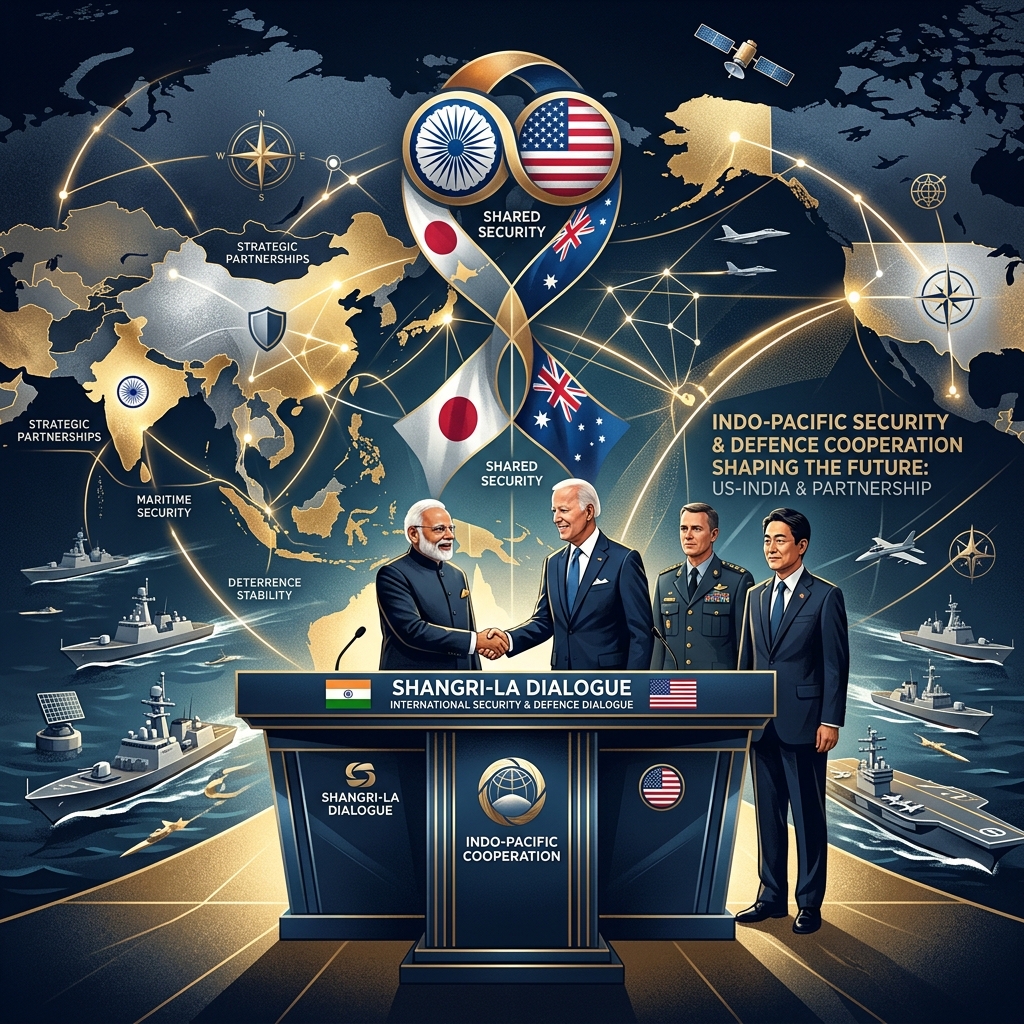
Speaking before a global gathering of military commanders and diplomats at the **Shangri-La Dialogue** in Singapore, U.S. Secretary of Defense **Pete Hegseth** delivered a major address outlining the United States’ updated Indo-Pacific strategy. Hegseth placed significant emphasis on the deepening strategic partnership with India, characterizing the nation as a vital anchor for regional security and economic stability.
During his address, the Defense Secretary also credited the diplomatic leadership of President Donald Trump for successfully de-escalating military tensions between India and Pakistan the previous year. The escalation had followed a devastating security incident in Pahalgam, Jammu and Kashmir, which resulted in 26 casualties.
India as a Crucial Regional Partner
Hegseth’s remarks highlighted a major bipartisan consensus in Washington: the strategic alignment between the United States and India is crucial for countering unilateral regional hegemony:
- Military Co-Production: The U.S. is actively pursuing deep industrial collaboration, including joint jet engine manufacturing and advanced drone production on Indian soil.
- Logistical Synergy: Expanding agreements to allow mutual access to military repair facilities, streamlining naval operations across the Indian Ocean.
- Strategic Modernization: Supporting India’s comprehensive modernization of its air defense, surveillance, and deep-strike capabilities to maintain a stable balance of power.
Balancing Diplomacy and Sovereignty
Hegseth noted that while the United States does not perceive either India or Pakistan as a threat to its security, it highly values a stable, peaceful coexistence between the two neighbors.
However, the Defense Secretary’s public acknowledgment of President Trump’s de-escalation role is balanced by India’s consistent diplomatic stance:
India has historically maintained that all bilateral understandings regarding peace, security, and ceasefires are negotiated directly between New Delhi and Islamabad, consistently declining any form of third-party external mediation.
Despite these diplomatic nuances, Hegseth concluded by reaffirming that the U.S. remains unwavering in its commitment to a free, open, and secure Indo-Pacific, where sovereign nations can pursue economic growth and security without coercion.