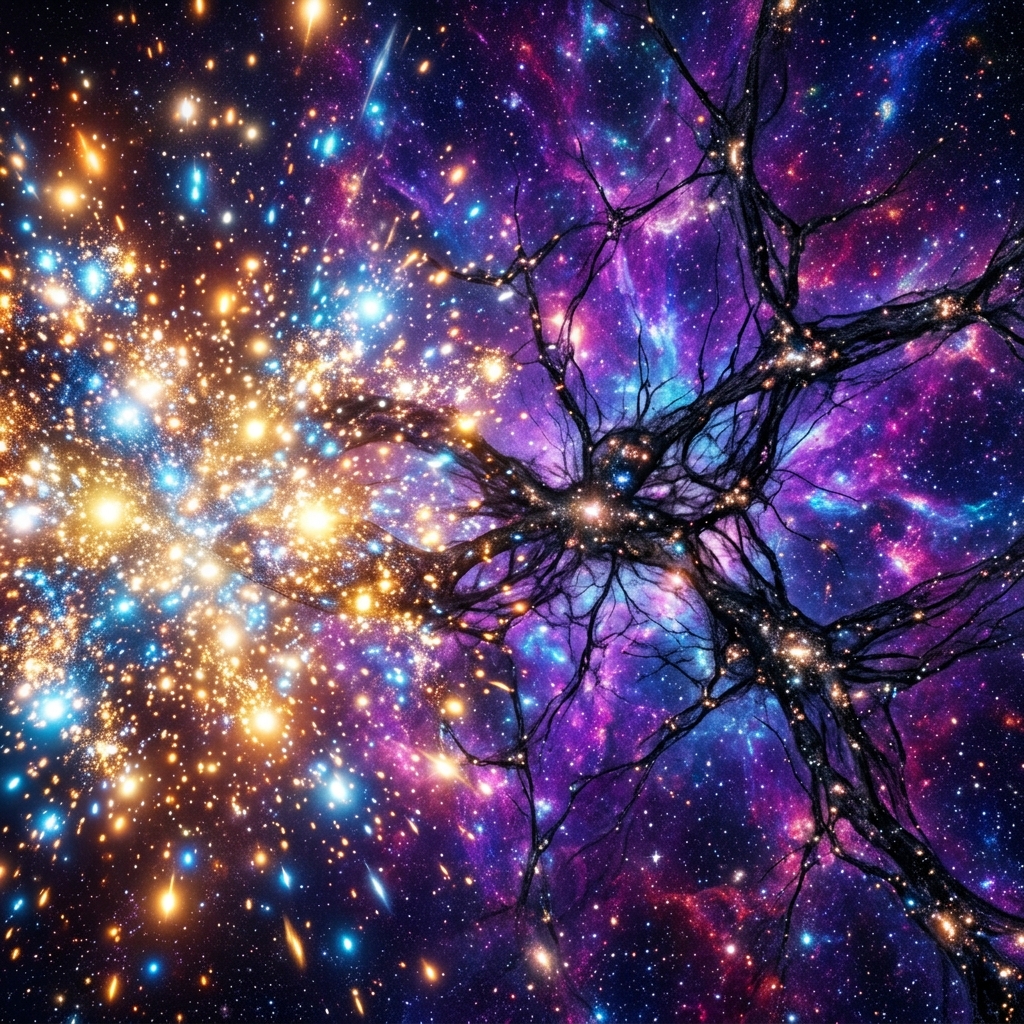
For decades, astronomers and physicists have grappled with one of the most elusive puzzles in the cosmos: the origin of dark matter. While we can observe its massive gravitational influence holding galaxies together, this invisible substance continues to escape direct detection. Now, a groundbreaking study by researchers at Dartmouth College has proposed a bold new theory that could fundamentally reshape our understanding of how this cosmic glue was born.
Publishing their findings in the prestigious journal Physical Review Letters, the research team outlines a novel physical mechanism where high-energy, massless particles traveling at the speed of light in the early universe collided, paired up, slowed down, and suddenly acquired significant mass—forming what we now recognize as cold dark matter.
The Particle Transition: How Massless Speed Rested Into Weight
Traditional cosmological models, such as the standard Cold Dark Matter (CDM) framework, generally assume that dark matter particles were born heavy and slow-moving from the very beginning. However, Dartmouth physics professor Robert Caldwell and graduate student Guanming Liang suggest a far more dynamic origin story:
- The Extreme Early Universe: Immediately following the Big Bang, the universe was an incredibly hot, dense plasma populated by hyper-fast, massless particles zipping around at the speed of light.
- The “Cooper Pair” Condensation: As the universe rapidly expanded and cooled, these light-speed particles collided. Under the right thermal conditions, they paired up. This physical grouping process is strikingly similar to how electrons form “Cooper pairs” in superconducting materials, or how steam condenses into water droplets.
- Slowing Down and Gaining Mass: Upon bonding, these newly formed particle pairs lost their high-velocity “zip.” They instantly acquired substantial mass, transitioning from hot radiation into a cold, nearly pressureless, slow-moving gas.
A Testable Hypothesis: Looking for the Cosmic Fingerprint
What makes this Dartmouth theory particularly compelling in the scientific community is its direct testability. Many theoretical dark matter models exist in realms that are currently impossible to observe or verify, but this model leaves a distinct signature:
- The CMB Signature: The rapid transition of light-speed particles into heavy, slow dark matter would have created microscopic gravitational perturbations in the early cosmic plasma.
- Observational Proof: These structural ripples would be imprinted as incredibly subtle thermal fluctuations in the Cosmic Microwave Background (CMB)—the ancient relic radiation from the Big Bang.
- Next-Gen Observatories: Ongoing and upcoming high-precision CMB projects, including the Simons Observatory in Chile and the international CMB Stage-4 (CMB-S4) project, possess the exact sensitivity required to search for and verify this unique cosmological fingerprint.
Solving the Cosmos’ Greatest Riddle
Dark matter accounts for roughly 85% of all matter in the universe, and 27% of its total mass-energy density. It acts as the gravitational scaffolding that allowed gas clouds to condense, stars to ignite, and galaxies like our own Milky Way to assemble.
If the Dartmouth team’s model is confirmed by next-generation CMB observations, it will solve a century-old cosmological mystery, showing that the dark matter shaping our night sky was forged when the fastest, lightest ingredients of the young cosmos decided to slow down and stand together.